

LA FAB.
Humanité
From 21 November 2025 to 26 April 2026
02 december 2025

La Fab. presents humanité, from the agnès b. collection — an exploration of the human condition through the lens of engaged artistic perspectives.
The exhibition humanity, drawn from the agnès b. Collection, will be on view from November 20, 2025, to April 26, 2026. Conceived as a poetic and thought-provoking journey, it brings together landmark works by photographers and artists whose practices are deeply rooted in social and political engagement. The title humanité resonates as an invitation to a profound and multifaceted exploration of what it means to be human. It proposes an immersion into what defines us collectively and individually — our emotions, our social bonds, our memories, our identities, and the fabric of our daily lives — as seen through the singular and sensitive gaze of artists. Humanity also evokes, intrinsically, our capacity to love, to connect, and to share intimacy — the very essence of our shared existence.
Portraits and Self-Portraits: Reflections of the Self, Reflections of the Other
The exhibition gathers a constellation of works centered on the representation of the individual — capturing inner worlds, affirming identity, and revealing the complexity of selfperception.
Among the featured artists, Seydou Keïta and Malick Sidibé offer timeless portraits that celebrate the elegance, dignity, and everyday vitality of life in Mali. Jean-Michel Basquiat’s Self-Portrait (1983), a vibrant and uncompromising work, portrays the artist with raw intensity. The sketched, almost totemic visage embodies both a quest for identity and a powerful assertion of African American heritage — a statement of presence within an art world still dominated by Eurocentric narratives. Here, self-representation becomes an act of resistance, reclamation, and empowerment.
Also presented is Mona Hatoum’s Keffieh (1993–1999), a traditional keffieh embroidered with human hair. Through this intimate and disquieting gesture, Hatoum transforms a political symbol of Palestinian resistance into a deeply personal meditation on identity, exile, and the body — a poetic and unsettling dialogue between fragility and defiance.
The Group, Society, and the Collective Scene
Several works in the exhibition address the human condition through its communal and social dimensions, highlighting group dynamics, collective identities, and shared spaces.
The works of Gilbert & George, such as Commercial Street and Phone, question coexistence, the image of the inseparable couple, and social conventions with both irony and striking visual intensity. Martin Parr’s photographs offer a sharp and often satirical observation of contemporary everyday life — its crowds, routines, and excesses.
Massimo Vitali’s large-scale images, depicting beaches and public spaces from a distance, compose bustling, almost cartographic scenes of humanity, where each figure appears at once singular and absorbed within the collective.
Love and Human Connection
A central focus of the exhibition is the representation of love, the couple, and the many forms of emotional relationships that bind individuals together.
Richard Billingham’s print Ray and Liz offers an intimate and unflinching portrait of a working-class couple, where tenderness and hardship coexist in the rawness of everyday life. In It’s About Queers in Love with Thei, Jared Buckhiester celebrates the diversity of queer love through a drawing marked by freedom and sensitivity. Other works from the collection — such as Seydou Keïta’s Untitled (Couple) and Couple allongé — further illustrate the richness of two-person relationships in their most universal and disarmingly simple forms.
Invented humanities: imaginary figures, myths, and hybridizations
Another central thread of the exhibition lies in the ways certain artists reinvent or project new forms of humanity through experimental and poetic visual languages.
Adrien Beau’s La Petite Sirène, crafted from wire, resin, wadding, shagreen, and lambskin, offers a contemporary and unsettling vision of a mythological hybrid figure — poised between fantasy and anatomy.
Annette Messager’s installation Deux clans, deux familles — composed of black-and-white photographs, plastic bags, stuffed animals, wood, and earth — confronts viewers with the notions of hierarchy and division within social and familial structures. Through the use of domestic and childlike materials, Messager evokes universal tensions that underlie our collective existence. The works of Pascal Doury, oscillating between collage and painting, construct a surreal and often provocative graphic universe inhabited by hybrid figures and fragmented corporeal motifs — a world where the human form is perpetually deconstructed and reimagined.
Universal Humanity, Political Humanity
Several works in the exhibition approach the notion of humanity through the lens of major political, cultural, and spiritual narratives — offering a collective reading of the world.
Alighiero e Boetti’s Mappa del Mondo, hand-embroidered by Afghan craftswomen, proposes a geopolitical reinterpretation of the globe, with each country represented by its national flag. Through this meticulous and participatory work, Boetti celebrates human diversity and the intricate bonds woven between cultures and territories.
The poetic creations of Frédéric Bruly Bouabré are also prominently featured, particularly his series Hommage aux femmes du monde (Homage to the Women of the World), comprising 200 ballpoint and colored-pencil drawings. In this ensemble, Bouabré celebrates the richness of feminine humanity and the often-forgotten stories that shape it. Other works — such as L’humanité se fraternise autour d’un même plat de riz ! Ainsi Dieu le veut ! (Humanity Shares a Single Dish of Rice! Thus God Wills It!) and Humanisation d’une table à manger en jouet collection F.B.B. — further express his vision of a humanistic, fraternal, and sacred world.
Finally, the vibrant, narrative paintings of Chéri Samba address social injustice and political contradiction with humor, lucidity, and critical insight. Humanity promises to be a rich and multifaceted exhibition — an invitation for every visitor to connect with shared emotions and visual stories that illuminate the beauty, complexity, and resilience of the human experience.
Humanity promises to be a rich and multifaceted exhibition — an invitation for every visitor to connect with shared emotions and visual stories that illuminate the beauty, complexity, and resilience of the human experience.
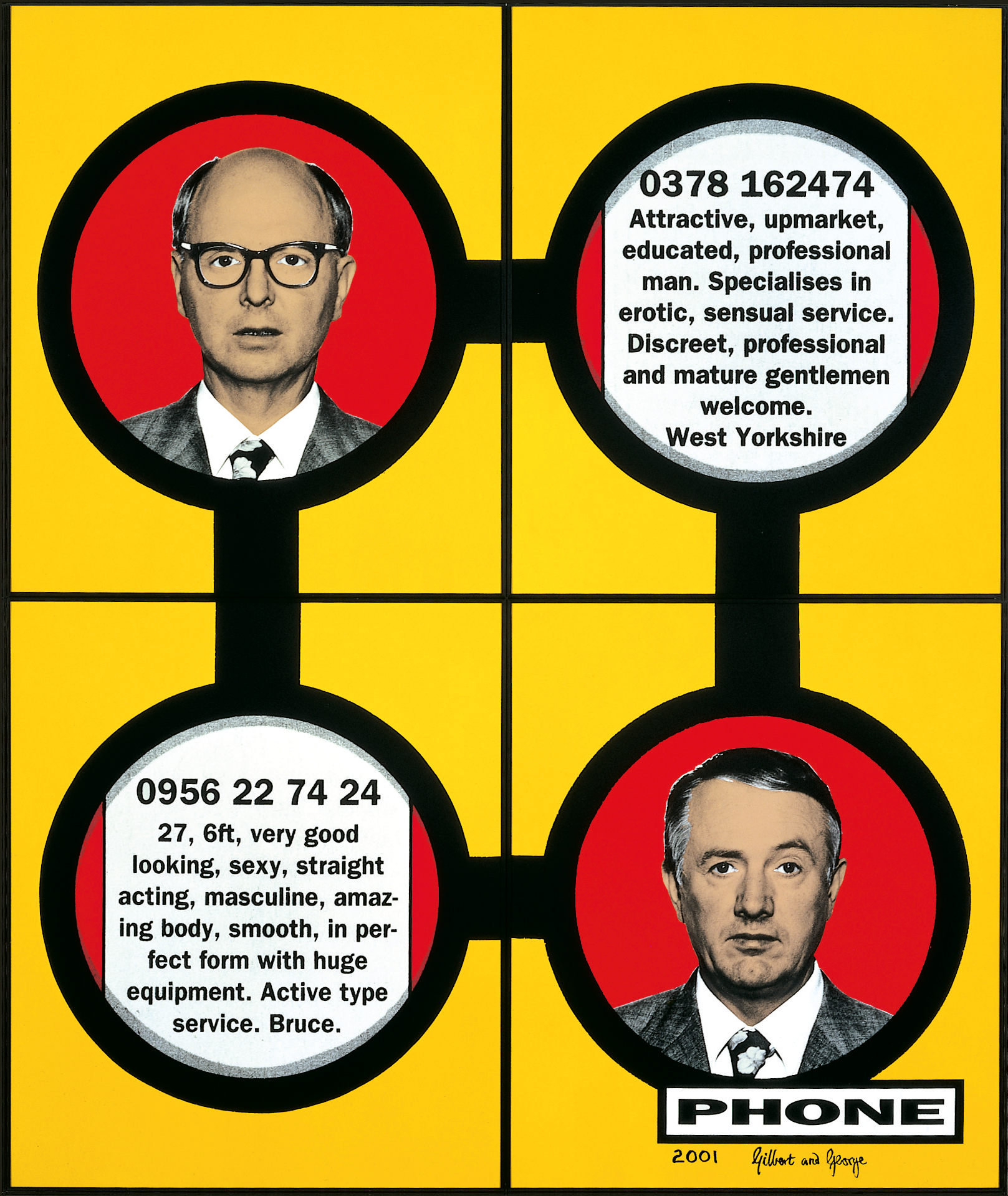
Phone, 2001 © Gilbert & George
A question of sharing and humanity.
The agnès b. endowment fund was created in 2009 to structure the artistic and charitable activities of the designer and collector.
In the field of solidarity, its support focuses on three historical pillars: the fight against HIV/AIDS, the fight against extreme poverty, and support for migrants. It also intervenes occasionally in humanitarian emergency situations.
Since the 1990s, the agnès b. brand has also offered charitable products, such as the red scarf against HIV/AIDS, sold in all stores to benefit various organizations.
The current major support from the agnès b. endowment fund is directed to the sea rescue association SOS MEDITERRANEE.
The Humanity exhibition will be an opportunity to highlight the organizations and initiatives supported through events and meetings.


 free delivery
 secure payment
 free returns
 customer service